When selecting industrial computers and monitors for demanding applications, engineers and system integrators often encounter two terms: Commercial Off-the-Shelf (COTS) and Military Standards (MIL-STD).
These terms describe different concepts. COTS identifies commercially available products, while MIL-STD refers to technical standards addressing specific engineering requirements and test methods.
Understanding the distinction helps engineers and integrators determine when a standard configuration is sufficient and when custom engineering becomes necessary.
One common misconception is that COTS equipment must already be manufactured, stored in a warehouse, and ready for immediate shipment.
In practice, commercially available equipment can be manufactured or configured after an order is placed. What matters is that the product follows an established commercial design rather than requiring unique development for each customer.
For industrial computers and monitors, standard configurations may include established combinations of processors, memory, storage, display technologies, power supplies, connectors, and enclosure designs.
This approach provides a practical foundation for equipment selection while reducing the need for application-specific engineering.
However, an important distinction applies to government procurement. Under the Federal Acquisition Regulation (FAR), COTS has a specific definition that includes restrictions on modifications when offered to the government.
Therefore, not every commercially based or customized product automatically qualifies as COTS under federal procurement rules.
Military Standards establish technical requirements, engineering practices, or test methods for equipment used in defense applications.
Unlike COTS, MIL-STD does not describe whether a product is commercially available.
Several standards frequently referenced in industrial and defense computing include:
Commercial products may be designed with applicable military requirements in mind.
However, compliance must be established for the relevant standard, revision, requirements, and test conditions. Meeting one standard does not imply compliance with others.
The term MIL-COTS is commonly used to describe commercially based equipment adapted for military applications. It is an industry designation, not an independent military certification.
While COTS generally relies on established commercial configurations and standard options, MIL-COTS may involve modifying an existing platform to accommodate specialized requirements.
This approach allows manufacturers to retain established product architectures while incorporating application-specific modifications.
Consider a rugged industrial computer whose standard motherboard cannot support a specialized communication interface required by a defense system.
Rather than designing an entirely new computer, the manufacturer may evaluate a different motherboard and modify the internal layout, thermal management, and electrical connections accordingly.
Similar adaptations may involve specialized connectors, alternative power inputs, mechanical modifications, or additional environmental protection.
The advantage is the ability to build upon an existing engineering foundation while addressing requirements that standard configurations cannot satisfy.
Such modifications must undergo appropriate engineering evaluation, and their impact on procurement classification must be considered separately.
Many demanding industrial applications share environmental and operational requirements with military systems.
Equipment used in mining, marine operations, energy production, and outdoor automation may face temperature extremes, vibration, shock, moisture, and electromagnetic interference.
Consequently, commercial equipment originally designed with applicable MIL-STD requirements in mind for demanding industrial environments may also be suitable for military applications, subject to appropriate verification.
Nevertheless, operating conditions vary. A computer installed inside an armored vehicle may face different mechanical and electrical challenges than a monitor integrated into a naval console or an outdoor industrial control station.
For engineers and integrators, several factors determine whether customization is necessary:
A product may satisfy its basic performance specifications yet remain unsuitable for installation without mechanical or electrical modifications.
Identifying these constraints early allows engineering teams to address integration challenges before production.
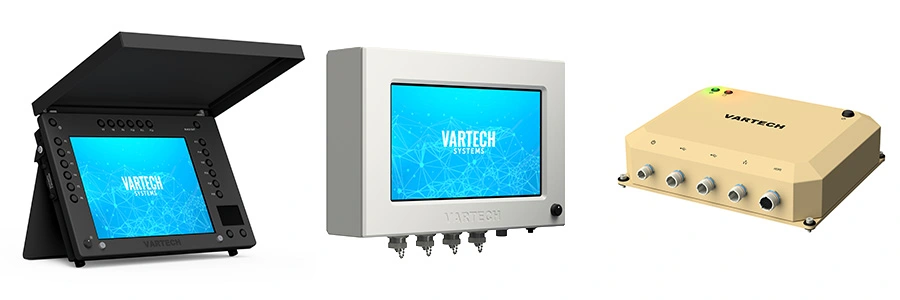
At VarTech Systems, standard commercial configurations and custom engineering are complementary capabilities.
Our industrial computing platforms provide established design foundations, while our engineering and manufacturing resources support adaptations driven by specific project requirements.

The All-Weather product line is one example of a platform supporting industrial and defense applications through available configurations and project-specific engineering.
Depending on the application, modifications may include alternative internal components, specialized I/O arrangements, custom mounting solutions, or changes to enclosure and electrical configurations.
Our in-house capabilities include metal fabrication, CNC machining, welding, assembly, and quality control. These resources allow mechanical and electrical requirements to be considered alongside manufacturing feasibility.
The goal is not customization for its own sake. It is to determine which elements of an existing design can be retained and which must change to meet the customer's requirements.
Choosing between a standard configuration and a tailored solution should begin with a clear understanding of the operating environment, integration constraints, and applicable technical standards.
When an established product meets those requirements, unnecessary modifications can add cost and complexity.
When standard configurations fall short, targeted engineering changes can provide a practical alternative to developing an entirely new system.
COTS and MIL-STD are not mutually exclusive. Commercial platforms originally engineered with military standards in mind for demanding industrial applications may also meet military requirements, provided applicable compliance criteria are satisfied.
At VarTech Systems, we support both standard COTS configurations and MIL-COTS approaches, combining established industrial computing platforms with custom engineering and in-house manufacturing capabilities to develop solutions tailored to specialized requirements.
Based in Clemmons, North Carolina, VarTech Systems Inc. engineers and builds custom industrial and rugged computers, monitors, and HMIs.