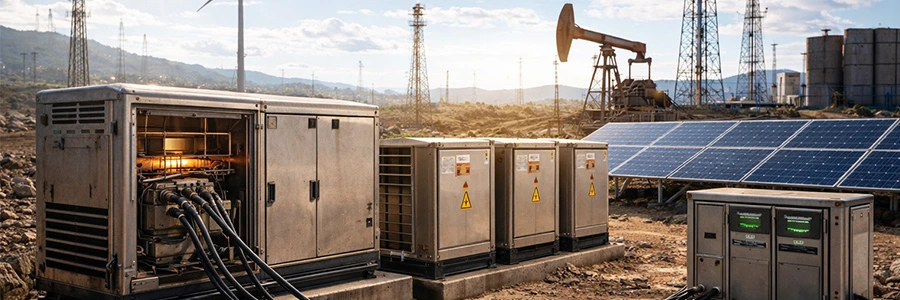
Off-grid industrial and defense operations depend on power systems that operate independently from public utilities while maintaining high reliability under adverse conditions.
Marine environments, mobile command centers, and remote oil and gas installations present unique constraints related to access, safety, and environmental exposure. Custom power solutions address these constraints through engineered combinations of generation, storage, and control systems designed to meet defined operational and regulatory requirements.
Off-grid power is commonly required in offshore platforms, remote drilling sites, coastal surveillance stations, and deployable military command units.
These locations may lack permanent infrastructure or may operate in conditions where grid connectivity is impractical or unreliable. In defense and emergency response scenarios, mobile command centers must be capable of rapid deployment and autonomous operation for extended periods. In marine environments, power systems must tolerate salt exposure, vibration, and continuous duty cycles while supporting mission-critical equipment.
Across these use cases, the power system is often classified as prime power rather than standby power, meaning it is expected to operate continuously and support full electrical loads without interruption.
Diesel and natural gas generators remain the primary source of sustained power in most off-grid industrial systems. They offer predictable output, high power density, and compatibility with a wide range of loads. In remote and marine applications, generators are typically specified for continuous operation and integrated into weather-resistant enclosures. Emissions compliance may be required depending on jurisdiction, particularly for long-term deployments.
Battery-based energy storage is commonly integrated to support load balancing, short-duration backup, and uninterrupted power during generator transitions. Lithium-ion technologies are increasingly used due to their energy density and cycle life, though lead-acid systems are still present in legacy or cost-sensitive deployments. In mobile command applications, battery systems enable temporary silent operation and improve power quality for sensitive electronics.
Hybrid systems combine generators and energy storage under a centralized control scheme. This architecture allows generators to operate closer to optimal load conditions while batteries handle transient loads and low-demand periods.
Hybridization is widely documented in industrial microgrid literature as a method to reduce fuel consumption, extend maintenance intervals, and improve system resilience. These systems are increasingly common in defense field power applications and remote industrial facilities.
Solar photovoltaic systems and, less commonly, small wind turbines may be integrated as supplemental power sources. In most industrial and defense off-grid deployments, renewables are not relied upon as the sole energy source due to intermittency. Their role is typically to offset generator runtime and support battery charging when environmental conditions permit.
Marine environments introduce corrosion risks due to salt exposure and high humidity. Enclosures and structural components are often fabricated from corrosion-resistant materials and sealed to prevent moisture ingress.
Standards such as NEMA 4X and IP66 are commonly specified to address water exposure and corrosion resistance. Equipment intended for maritime use may also be evaluated under salt fog and vibration test methods defined in MIL-STD-810.
Mobile command systems and transportable power units are subject to repeated shock and vibration during movement and operation. Mechanical mounting, cable retention, and connector selection must account for these stresses.
Military and defense-oriented systems frequently refer to MIL-STD-810 methods for vibration and mechanical shock to validate durability under transport and field conditions.
Oil and gas facilities and certain marine installations may be classified as hazardous locations due to the presence of flammable gases or vapors. Power systems installed in these areas must comply with applicable electrical codes and classifications such as Class I, Division 2.
This may require the use of explosion-protected components, pressurized enclosures, or restricted surface temperatures. Compliance is typically aligned with NEC, IEC, or ATEX frameworks, depending on jurisdiction.
Off-grid systems often serve a mix of heavy inductive loads and sensitive electronic equipment. Large motors, HVAC systems, and pumps can impose high starting currents, while communications and computing equipment require stable voltage and frequency.
System design must account for transient response, harmonic distortion, and electromagnetic compatibility. In defense-related systems, electromagnetic emissions and susceptibility are often evaluated with reference to MIL-STD-461.
Because off-grid systems lack external backup, redundancy is a core design principle. Common approaches include multiple generators operating in parallel, N+1 configurations, and redundant energy storage paths. Automatic transfer and control systems are used to manage faults and transitions without interrupting critical loads. Preventive maintenance and monitoring are also essential to sustaining long-term reliability in remote deployments.
Custom off-grid power solutions are typically designed within established standards frameworks rather than proprietary criteria. Environmental durability is commonly addressed through MIL-STD-810 test methods.
Electrical enclosure protection is defined through NEMA and IP ratings. Hazardous location compliance follows NEC Class and Division definitions or international equivalents. Electromagnetic compatibility may be evaluated using MIL-STD-461 or comparable civilian standards. These frameworks provide a common technical baseline for engineers, integrators, and end users.
To summarize, custom power solutions for off-grid industrial applications are defined by engineering discipline rather than generic product selection. Marine installations, mobile command centers, and remote industrial sites require power systems that balance continuous operation, environmental resistance, safety compliance, and operational flexibility.
By integrating generators, energy storage, and intelligent controls within recognized standards, these systems enable autonomous operation in locations where grid power is unavailable or impractical. In industrial and defense contexts, off-grid power is not a convenience but a foundational capability that supports mission continuity under demanding conditions.
Based in Clemmons, North Carolina, VarTech Systems Inc. engineers and builds custom industrial and rugged computers, monitors, and HMIs.