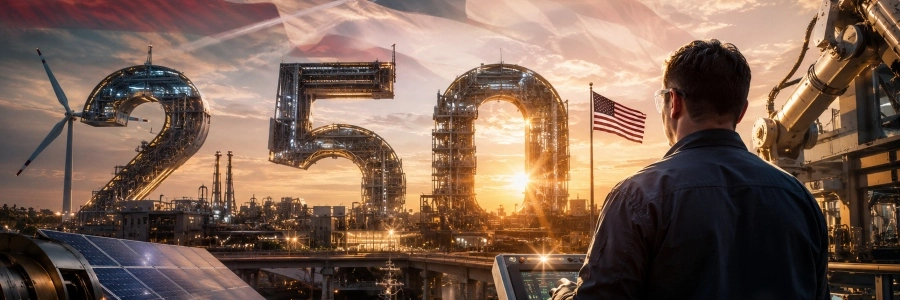
As the United States celebrates its Semiuincentennial, U.S. manufacturing remains one of the nation's greatest competitive advantages. American industrial innovation has always been driven by the ability to design, engineer, manufacture, and support reliable technologies for demanding industries. As manufacturing continues to evolve, companies capable of delivering dependable industrial solutions will play a critical role in shaping the nation's next chapter.
Ideas alone do not strengthen critical industries. They must become products capable of operating in demanding environments, integrating with increasingly complex systems, and delivering dependable performance for years or even decades. That transformation is only possible through disciplined engineering and advanced manufacturing.
Today, manufacturing has evolved far beyond production lines. Modern facilities are intelligent ecosystems where automation, artificial intelligence, robotics, machine vision, Industrial Internet of Things (IIoT) devices, and edge computing work together to improve productivity, quality, and operational resilience.
Every connected machine generates data. Every sensor contributes to operational insight. Every production asset becomes part of a larger digital infrastructure that enables manufacturers to optimize performance, reduce downtime, improve product quality, and respond more quickly to changing operational demands.
This transformation has changed the role of manufacturing itself. Success is no longer measured solely by production volume. It is measured by efficiency, adaptability, lifecycle support, cybersecurity, and the ability to maintain continuous operations under increasingly demanding conditions.
Recent supply chain disruptions have demonstrated the importance of domestic manufacturing for organizations operating in defense, energy, transportation, food processing, pharmaceuticals, marine, mining, and industrial automation.
While cost remains an important consideration, resilience has become equally valuable.
Manufacturing close to engineering teams shortens development cycles, accelerates design improvements, simplifies quality control, and provides faster technical support throughout a product's operational life. Organizations also benefit from more predictable lead times, greater supply chain transparency, and improved long-term product availability.
For industries where equipment downtime can disrupt production, delay missions, or affect public infrastructure, these advantages provide measurable operational value.
Domestic manufacturing has therefore become more than a sourcing strategy. It has become a competitive advantage.
Artificial intelligence is transforming industrial operations, but AI cannot function independently.
Machine learning models rely on continuous streams of reliable operational data collected from cameras, sensors, programmable logic controllers, industrial networks, and Human Machine Interface (HMI) systems. That information must often be analyzed immediately to support automated decisions, predictive maintenance, quality inspection, robotics, and process optimization.
This is where edge computing becomes essential.
By processing data closer to where it is generated, edge computing reduces latency, minimizes bandwidth requirements, strengthens cybersecurity, and allows critical operations to continue even when cloud connectivity is unavailable or limited.
As manufacturers continue adopting AI-driven technologies, the reliability of the underlying computing infrastructure becomes increasingly important.
Industrial computers have become one of the most important components of smart manufacturing.
Unlike commercial office computers, industrial systems are specifically engineered for continuous operation in environments where dust, vibration, moisture, electrical noise, washdown procedures, corrosive atmospheres, and extreme temperatures are part of normal daily operations.
These systems power HMI platforms, SCADA applications, industrial automation, robotics, machine vision, edge AI, process control, and data acquisition systems that operate around the clock.
Their value is measured less by benchmark performance than by operational reliability.
An industrial computer that continues operating reliably after years of continuous service often delivers greater business value than one offering marginally higher processing performance but requiring frequent maintenance or replacement.
For manufacturers pursuing digital transformation, dependable computing infrastructure is no longer optional. It has become a critical operational asset.
Breakthrough innovations often receive public attention. The engineering discipline delivers lasting results.
Small improvements in thermal management, environmental sealing, mechanical design, vibration resistance, component selection, serviceability, and lifecycle management collectively determine whether industrial equipment continues performing reliably throughout years of demanding operation.
These engineering decisions directly influence maintenance costs, equipment availability, production efficiency, and total cost of ownership.
Organizations investing in industrial technology increasingly evaluate equipment not only by its specifications, but by its long-term reliability, upgrade path, and lifecycle support.
Engineering excellence ultimately determines whether innovation becomes sustainable operational capability.
The future of American manufacturing will not be defined solely by new technologies. It will be shaped by companies capable of transforming innovation into dependable products.
This requires engineering expertise, advanced manufacturing capabilities, long-term product support, and a commitment to continuous improvement.
For more than 37 years, VarTech Systems has designed, manufactured, and assembled industrial computers, rugged displays, and HMI solutions in the United States for organizations operating in defense, manufacturing, transportation, energy, marine, mining, food processing, and other mission critical industries.
That experience reflects a broader principle that extends across American industry.
Manufacturing leadership is built through engineering discipline, operational reliability, and the ability to support customers long after products leave the factory.
As the United States enters its next 250 years, the manufacturers that will lead the future are not simply those introducing the next technological breakthrough. They will be the organizations capable of designing resilient systems, manufacturing them to the highest standards, and supporting them throughout their entire operational lifecycle.
Innovation begins with an idea.
Engineering transforms that idea into a dependable solution.
Manufacturing delivers that solution to the industries that keep America moving.
Based in Clemmons, North Carolina, VarTech Systems Inc. engineers and builds custom industrial and rugged computers, monitors, and HMIs.