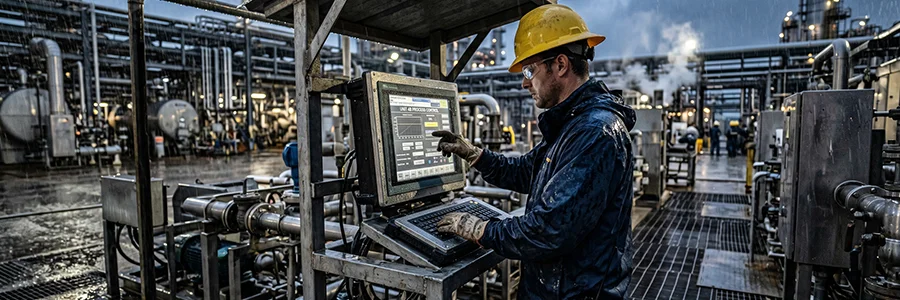
In industrial electronics, failure rarely occurs in the processor or the display. It starts at the enclosure interface.
Every industrial computer, monitor, or HMI operates within an environment that is actively working against it. Moisture migrates. Dust accumulates. Chemicals attack surfaces. Temperature changes create pressure differentials.
The gasket is the only barrier that prevents the environment from reaching electronics.
When sealing is treated as a secondary detail, the enclosure is no longer a protective system. It becomes a delayed failure mechanism.
Sealing is a mechanical system, not a component
A gasket does not function in isolation. Its performance depends on a closed system of variables:
If one variable is misaligned, the seal fails.
This is why two enclosures using the same gasket material can perform very differently in the field. The outcome is defined by the system, not the material alone.
Sealing performance also evolves over time. Initial compression can be correct, yet relaxation, creep, or mechanical fatigue can reduce sealing force after months of operation. This time-dependent behavior is often overlooked during design and only becomes visible once failures appear in the field.
The most damaging failures are not catastrophic. They are progressive:
These mechanisms are well understood in reliability engineering. They are not random events. They follow consistent physical processes driven by diffusion, pressure differentials, and material degradation.
Effective sealing depends on controlling specific mechanical properties.
This defines how well a gasket returns to its original thickness after being compressed. Materials with poor compression set remain permanently deformed. Once that happens, sealing pressure drops and leak paths develop. It is one of the most common causes of long-term failure in outdoor systems.
Measured on the Shore scale, the durometer determines how the gasket behaves under load. A softer gasket conforms better to surface irregularities but may extrude under pressure. A harder gasket resists deformation but requires higher compression forces to seal properly.
Selecting the wrong durometer leads to either leakage or mechanical instability.
Different environments require different elastomers:
Material selection must be aligned with the actual exposure profile, not a generic specification.
Uniform sealing requires uniform pressure. This is controlled through fastener spacing, torque, and enclosure rigidity.
Wide gaps between fasteners create localized low-pressure zones. These become entry points for moisture and dust.
Surface finish also plays a role. Even minor machining inconsistencies can prevent full gasket contact, especially in rigid enclosures where the gasket must compensate for imperfect flatness.
Gasket's design is directly tied to enclosure ratings, but standards define outcomes, not methods.
IP67 and IP68 require complete protection against dust and varying levels of water immersion. Achieving this depends on continuous sealing without discontinuities.
NEMA 6 includes protection against hose-directed water and temporary submersion. It also considers environmental durability beyond ingress alone.
This standard evaluates performance under vibration, shock, humidity, and temperature cycling. A gasket must maintain sealing integrity under all these conditions.
Passing these standards is not a labeling exercise. It requires consistent sealing performance under test conditions that simulate real deployment.
In controlled environments, most sealing strategies work.
In real deployments, conditions vary:
A gasket that performs well in static conditions may fail under dynamic stress.
Altitude can also influence sealing performance. Changes in external pressure create differential forces across the enclosure, stressing the gasket, and potentially drawing moisture inward if sealing is inconsistent.
Most sealing failures are not due to extreme conditions. They result from design decisions:
These are predictable errors. They lead to predictable failures.
Gasket design does not improve performance. It preserves it.
Electronics define what the system can do. The seal defines whether it continues to do it.
In environments where moisture, dust, and chemicals are constant, sealing is not a secondary feature. It is the condition that makes the operation possible.
Based in Clemmons, North Carolina, VarTech Systems Inc. engineers and builds custom industrial and rugged computers, monitors, and HMIs.