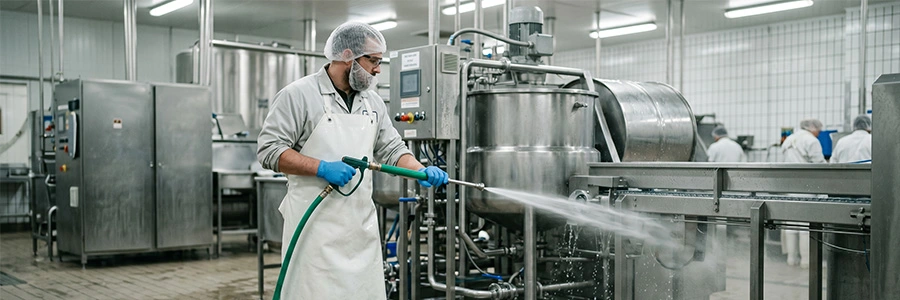
Food and beverage production environments impose a specific type of stress on industrial equipment. It is not limited to moisture exposure.
Equipment is routinely subjected to high-pressure cleaning, elevated water temperatures, and chemical agents designed to remove organic residue. Under these conditions, enclosure protection must be evaluated against washdown performance, not general ingress resistance. IP69K addresses this requirement.
What IP69K Requires
IP69K is defined in DIN 40050-9 and later incorporated into ISO frameworks for ingress protection. It represents the most severe condition within the IP rating system for water exposure.
To achieve IP69K, an enclosure must prevent water ingress under a controlled but aggressive test:
Each variable is intentional. High temperature reduces fluid viscosity and accelerates material expansion. Pressure forces water into micro-gaps. Short distance increases impact energy. Multiple angles ensure that sealing is not directional.
This is not a generalized “waterproof” condition. It is a targeted simulation of aggressive washdown procedures used in hygienic industries.
IP69K is not achieved by enclosure thickness or material alone. It imposes constraints on the entire mechanical and sealing system.
Gaskets must maintain compression despite thermal expansion and contraction. Loss of compression creates immediate ingress paths under pressure.
Repeated transitions between ambient temperature and 80°C washdown cycles induce material fatigue. Elastomers, adhesives, and bonding interfaces must tolerate this without degradation.
Cable glands, connectors, seams, and fastener interfaces must all be sealed. Under high-pressure spray, even minor discontinuities become failure points.
Geometry influences how water interacts with the enclosure. Flat surfaces and recessed features increase dwell time and pressure concentration. Sloped and smooth surfaces promote runoff and reduce exposure duration.
Although IP69K does not test chemical resistance directly, food processing environments include alkaline and acidic cleaning agents. Materials must tolerate these conditions without swelling, cracking, or losing sealing performance.
In practical terms, IP69K demands a system that maintains integrity under combined mechanical, thermal, and fluid stress. Passing the test once is insufficient if the design cannot sustain these conditions over time.
The need for IP69K depends on exposure, not industry label. Within the same facility, different zones require different levels of protection.
These conditions are common in:
Regulatory oversight from entities such as the FDA and the USDA enforces sanitation outcomes, not specific enclosure ratings. However, the cleaning methods used to meet those requirements often necessitate IP69K-level protection.
Over-specification increases cost and complexity without improving reliability if exposure conditions do not justify it.
IP ratings are often misapplied because they address different failure modes.
In North America, NEMA 4X is frequently specified. It includes protection against hose-directed water and corrosion. However, it does not replicate the thermal and pressure extremes defined in IP69K testing.
An enclosure may meet NEMA 4X and still experience failure under repeated high-pressure, high-temperature cleaning cycles if sealing and material selection are not designed for those conditions.
IP69K and IP67 address different exposure conditions and should not be treated as interchangeable. IP67, defined under IEC 60529, validates protection against temporary immersion in water under controlled depth and duration. IP69K, defined in DIN 40050-9, evaluates resistance to high-pressure, high-temperature spray from multiple angles.
An enclosure designed for IP67 may perform reliably in environments with moisture, washdown residue, or incidental exposure to water, but it is not validated for direct, close-range, high-pressure cleaning. VarTech Systems’ products are engineered to meet IP67 requirements, focusing on maintaining sealing integrity in harsh outdoor and industrial conditions where immersion, dust ingress, and environmental exposure are primary concerns.
In food and beverage facilities, IP69K is typically required only in zones with direct exposure to aggressive washdown procedures. In many installations, equipment is either shielded from direct spray or positioned outside primary cleaning paths.
In these cases, an IP67-rated system can provide reliable operation in areas not exposed to direct high-pressure, high-temperature washdown, without the added complexity associated with IP69K design constraints, such as fully sealed thermal management and specialized connector systems.
The selection should be driven by actual exposure conditions rather than assuming maximum protection is always necessary.
Specifying IP69K has direct implications for equipment design and integration.
Single-point sealing is insufficient. Designs often require continuous gaskets with controlled compression and repeatable assembly processes.
Surface flatness and fastener torque affect sealing performance. Variability introduces localized gaps that fail under pressure.
Standard connectors are frequent failure points. Sealed connectors or isolated I/O compartments are required.
Airflow-based cooling conflicts with sealed enclosures. Heat must be dissipated through conduction or external surfaces.
Design must prevent accumulation of contaminants. This aligns with cleanability requirements but also reduces prolonged exposure to water jets.
These are engineering constraints, not optional enhancements. IP69K compliance reshapes how the entire system is designed.
IP69K is often treated as a marketing label rather than a functional requirement. This leads to two common errors:
Failure in washdown environments is rarely immediate. It develops through repeated exposure, gradual seal degradation, and unnoticed ingress.
When IP69K is required but not properly implemented, the result is predictable:
IP69K should be treated as a response to a defined cleaning process. It is not a default requirement for all food and beverage equipment.
The correct approach is:
When these steps align, IP69K becomes a functional specification that reflects real operating conditions rather than a generic upgrade in protection.
Based in Clemmons, North Carolina, VarTech Systems Inc. engineers and builds custom industrial and rugged computers, monitors, and HMIs.