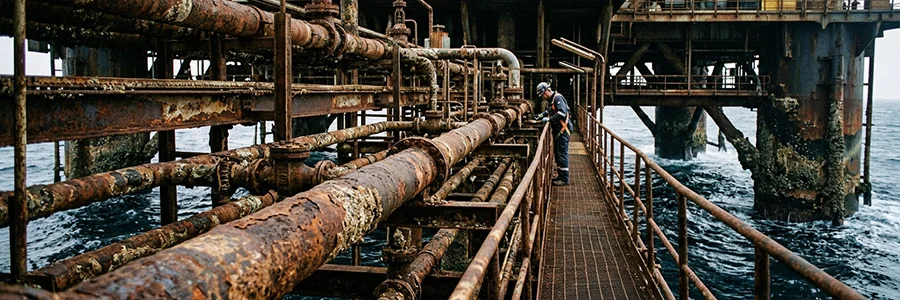
Rugged industrial computers rarely operate in controlled conditions typical of office environments. Many systems are deployed in offshore oil and gas facilities, coastal installations, heavy manufacturing plants, and other locations where industrial computer enclosures are exposed to humidity, vibration, temperature variation, salt spray, and corrosive atmospheres.
In these environments, the durability of industrial computer enclosures is strongly influenced by material selection. The metals, polymers, and protective coatings used in a system’s enclosure and structural components determine how well the equipment resists corrosion, mechanical stress, and long-term environmental exposure.
For engineers and system integrators working in offshore and industrial sectors, understanding how different materials behave under harsh conditions is essential when specifying reliable computing equipment.
Electronic reliability is often associated with processors, circuit boards, and power systems. However, mechanical materials play an equally important role in determining system longevity.
Industrial computers must protect sensitive electronics from external hazards such as salt spray, airborne contaminants, moisture ingress, and mechanical shock. If the enclosure materials degrade or corrode, environmental exposure can eventually reach internal components.
Material selection therefore affects several critical performance factors:
A well-designed industrial computer integrates these material considerations directly into the enclosure and mechanical architecture.
Metal enclosures provide structural strength, electromagnetic shielding, and environmental protection. Several metals are commonly used in rugged computing systems.
Widely used in industrial computer enclosures because they combine low weight, good corrosion resistance, and high thermal conductivity. These properties make aluminum particularly suitable for fanless rugged systems where the enclosure acts as a heat spreader.
Provides higher mechanical strength and improved resistance to corrosion, especially in environments containing moisture or airborne salts. Stainless steel 316 is frequently selected for marine or offshore installations due to its improved resistance to chloride exposure.
Sometimes used for structural elements where strength is required. Because carbon steel corrodes rapidly in humid environments, it must be protected through coatings, plating, or galvanization.
When multiple metals are used within the same enclosure assembly, engineers must also consider galvanic compatibility to prevent corrosion caused by electrical interaction between dissimilar materials.
Protective coatings significantly extend the lifespan of industrial equipment by isolating the base metal from the surrounding environment. Several coating methods are commonly used in rugged electronic systems:
Powder coating creates a durable surface layer that resists abrasion and environmental exposure. It is widely used on industrial enclosures and mechanical frames.
Anodizing is frequently applied to aluminum enclosures. The process thickens the natural oxide layer on the metal surface, improving corrosion resistance and surface hardness.
Stainless steel parts can undergo passivation treatments that remove contaminants and enhance the chromium oxide protective layer responsible for corrosion resistance.
When coatings are correctly applied and maintained, they can significantly reduce corrosion risks in humid or salt rich environments.
Metals provide structural protection, but polymers play a critical role in sealing and environmental isolation.
Industrial computers rely on polymer materials in several key areas:
Elastomer sealing materials such as silicone or EPDM are commonly used in industrial enclosures because they maintain flexibility across wide temperature ranges and resist environmental degradation, salt exposure, and many industrial chemicals.
The choice of sealing material influences whether the enclosure can maintain protection levels such as IP65, IP67, or higher.
In harsh environments, poorly selected gasket materials may harden, crack, or lose elasticity, allowing moisture or contaminants to enter the enclosure.
Material choice also affects how industrial computers handle heat.
Electronic components generate heat during operation, and that heat must be transferred away from sensitive circuits. Metals with high thermal conductivity help move heat toward the exterior surfaces of the enclosure where it can dissipate into the surrounding air.
Aluminum alloys are often preferred for rugged systems because they conduct heat efficiently while remaining lightweight.
This characteristic is particularly important in fanless industrial computers, where passive cooling relies on enclosure surfaces to act as heat spreaders.
Durability in harsh environments rarely depends on a single material decision. Instead, reliability results from combining corrosion resistant metals, protective surface treatments, and effective sealing materials within a well-engineered enclosure.
Manufacturers that design rugged computing systems for offshore and industrial installations typically integrate these considerations directly into the mechanical architecture of their products. In systems intended for marine or coastal deployment, materials such as corrosion resistant stainless steel and treated aluminum alloys are often combined with specialized coatings and sealing methods to improve long term environmental durability.
For integrators working in offshore oil and gas, marine infrastructure, or heavy industrial facilities, evaluating material construction should be part of the equipment selection process.
Material specifications influence how well an industrial computer resists corrosion, mechanical fatigue, and environmental exposure over years of operation.
Systems designed with appropriate metals, protective coatings, and durable sealing materials typically require less maintenance and experience fewer failures in demanding environments.
While electronics determine computing performance, materials engineering often determines whether those systems remain operational under the harsh conditions found in offshore and industrial installations.
Based in Clemmons, North Carolina, VarTech Systems Inc. engineers and builds custom industrial and rugged computers, monitors, and HMIs.